



If you’re waiting for a green card, few documents matter more than the US Visa Bulletin. Published monthly by the U.S. Department of State, this single page determines whether you can move forward with your application, or whether you’ll spend another month (or year) waiting in line.
The USCIS Visa Bulletin can be confusing at first glance. It’s filled with dates, categories, and country-specific columns that don’t make intuitive sense without context. This guide breaks down everything you need to know to read the bulletin, find your priority date, and understand what it means for your immigration timeline.
What Is the US Visa Bulletin?

The US Visa Bulletin is a monthly report that shows which green card applicants have reached the front of the line and can proceed with their applications.
It exists because of a fundamental mismatch: more people want green cards than are available each year. Congress caps the total number of green cards at approximately 366,000 annually, divided between family-based categories (roughly 226,000) and employment-based categories (roughly 140,000). When demand exceeds supply, which it consistently does, a backlog forms.
The Visa Bulletin, with its latest version being the December Visa Bulletin, tracks these backlogs and informs applicants when their turn comes.
Why Backlogs Exist
Two factors create green card backlogs.
The first is overall demand. There are simply more qualified applicants than available slots in most preference categories. This creates a queue, and the USCIS Bulletin shows where the front of that queue currently sits.
The second factor is the per-country limit. No single country can receive more than 7% of the green cards in any category. This cap doesn’t create problems for applicants from smaller countries, but it creates massive backlogs for applicants from high-demand countries like India, China, Mexico, and the Philippines. An Indian national in the EB-2 category might wait a decade or more, while someone from France with identical qualifications could have a green card within a year.
Finding Your Priority Date
Your priority date is essentially your place in line. It’s the date that anchors your position in the green card queue.
For employment-based green cards, your priority date is typically the date your employer filed your PERM labor certification with the Department of Labor. If your category doesn’t require labor certification (like EB-1A for extraordinary ability or EB-2 National Interest Waiver), your priority date is the date USCIS received your I-140 petition.
For family-based green cards, your priority date is the date USCIS received your I-130 petition.
You can find your priority date on your I-797 approval notice; it’s listed explicitly on the form.
Understanding the Two Charts
Every US Visa Bulletin contains two separate charts for both family-based and employment-based categories: “Final Action Dates” and “Dates for Filing.” These serve different purposes.
Final Action Dates (Chart A)
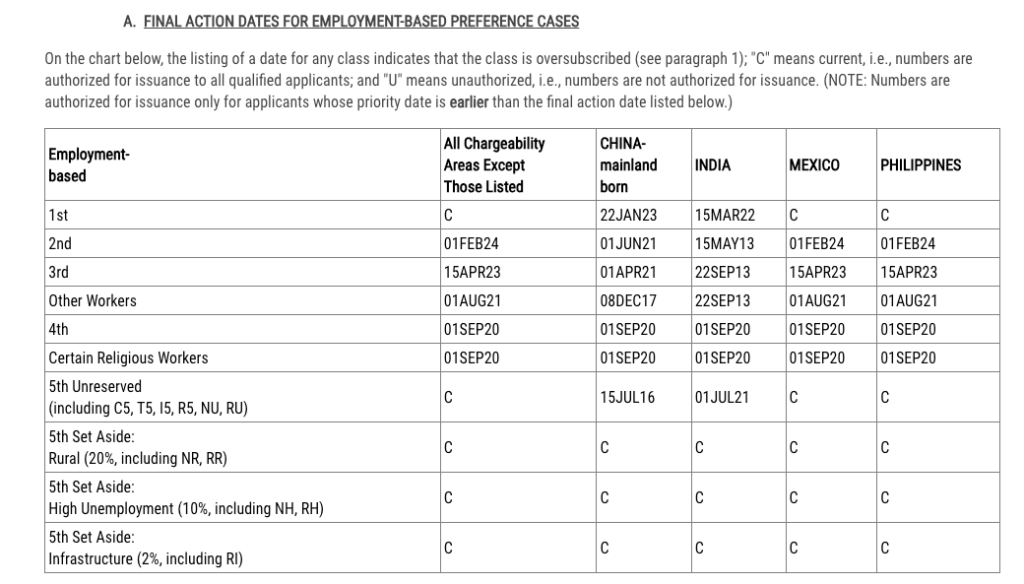
This chart shows which priority dates have reached the front of the line. If your priority date is earlier than the date indicated in your category, you are eligible for a green card now, and your application can be approved.
Think of Final Action Dates as the finish line. Once your h1b green card priority date appears here, you’re eligible for a green card.
Dates for Filing (Chart B)
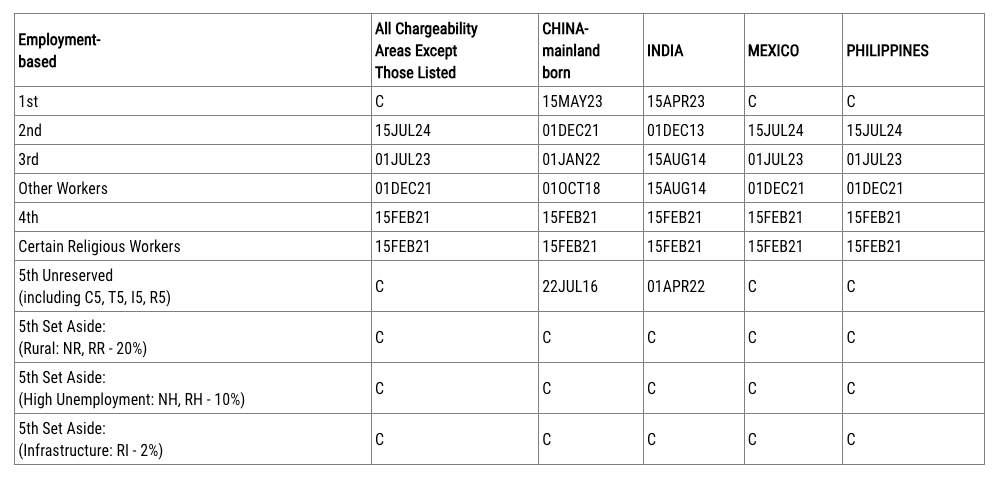
This chart shows when you can submit your green card application—even if a visa isn’t immediately available. The dates here are typically a few months ahead of the Final Action Dates.
Why does this matter? For applicants inside the United States, filing your I-485 adjustment of status application unlocks essential benefits. You can simultaneously apply for a work permit (Employment Authorization Document) and travel permit (Advance Parole), which lets you work and travel while your green card application is pending.
For applicants outside the United States, the Dates for Filing chart tells you when to submit your documents to the National Visa Center so everything is ready when a visa number becomes available.
Which Chart Should You Use?
USCIS publishes guidance each month indicating which chart applies to adjustment-of-status applicants. Check their “When to File” page after each new US Visa Bulletin is released. The National Visa Center generally follows the Dates for Filing chart for consular processing cases.
Employment-Based Green Card Categories
The USCIS Visa Bulletin tracks five employment-based preference categories, each with its own line and backlog.
EB-1: Priority Workers
This category covers three subcategories: individuals with extraordinary ability (EB-1A), outstanding professors and researchers (EB-1B), and multinational managers and executives (EB-1C). The annual cap is approximately 40,040 visas.
EB-1 has historically moved faster than other employment categories because it represents the highest-priority workers. However, backlogs have developed in recent years, particularly for Indian and Chinese nationals.
EB-2: Advanced Degree Professionals and Exceptional Ability
This category includes professionals with advanced degrees (master’s or higher) and individuals with exceptional ability in their field. It also consists of the National Interest Waiver (NIW), which allows applicants to self-petition without employer sponsorship if their work benefits the United States. The annual cap is approximately 40,040 visas.
EB-2 has significant backlogs for Indian nationals, often exceeding a decade, while remaining relatively current for applicants from other countries.
EB-3: Skilled Workers, Professionals, and Other Workers
This category covers skilled workers (jobs requiring at least two years of training), professionals (jobs requiring a bachelor’s degree), and other workers (unskilled labor). The annual cap is approximately 40,040 visas.
EB-3 backlogs vary significantly by country and subcategory.
EB-4: Special Immigrants
This category includes religious workers, certain employees of U.S. foreign service posts, and other special immigrant classifications. The annual cap is approximately 9,940 visas.
EB-5: Immigrant Investors
This category is for individuals who invest a substantial amount in a U.S. business that creates jobs. The standard investment threshold is $1,050,000, or $800,000 for investments in targeted employment areas. The annual cap is approximately 9,940 visas.
Family-Based Green Card Categories
The bulletin also tracks four family-based preference categories.
F1: Unmarried Adult Children of U.S. Citizens
Adults (21 and older) who are unmarried children of U.S. citizens. Annual cap: 23,400 visas.
F2A: Spouses and Minor Children of Green Card Holders
Spouses and unmarried children (under 21) of lawful permanent residents. This subcategory moves faster than others because 75% of its visas are exempt from the per-country cap.
F2B: Unmarried Adult Children of Green Card Holders
Unmarried adults (21 and older) who are children of lawful permanent residents.
F3: Married Children of U.S. Citizens
Married children of U.S. citizens, regardless of age. Annual cap: 23,400 visas.
F4: Siblings of U.S. Citizens
Brothers and sisters of adult U.S. citizens. Annual cap: 65,000 visas. This category has the lengthiest backlog, often exceeding 20 years for applicants from the Philippines.
Immediate Relatives: No US Visa Bulletin Required
Spouses, parents, and unmarried minor children of U.S. citizens are classified as immediate relatives. There is no cap on immediate relative green cards, which means no backlog, no priority date, and no need to check the USCIS Visa Bulletin. These applicants can proceed as soon as their petition is approved.
Reading the Country Columns
The USCIS Bulletin includes separate columns for China, India, Mexico, and the Philippines. Applicants from these four countries face longer waits because demand from each exceeds the 7% per-country cap.
If you were born in one of these countries, use the column specific to your country of birth. If you were born anywhere else, use the “All Chargeability Areas Except Those Listed” column.
Your chargeability is based on country of birth, not citizenship or current residence. However, there are limited exceptions—for example, you may be able to use your spouse’s country of birth if it has a shorter backlog.
What Does “Current” Mean?
When a category shows “C” or “Current” instead of a date, it means there is no backlog. All applicants in that category can file immediately, regardless of their priority date.
Current status can change from month to month. A category that’s current today might develop a backlog next month if demand spikes.
What Is Retrogression?
Retrogression occurs when the cut-off dates in the USCIS news bulletin move backward instead of forward. This typically happens when USCIS receives more applications than anticipated in a given category, forcing the State Department to slow the queue.
Retrogression is most common near the end of the federal fiscal year (September) when agencies reconcile their numbers. It can also happen unexpectedly at any time of year.
If you’ve already filed your green card application and retrogression occurs, USCIS will hold your application until your priority date becomes current again. You don’t need to refile—just wait.
If you haven’t filed yet and retrogression occurs, you’ll need to wait until the dates move forward again before submitting your application.
This is why immigration attorneys often recommend filing as quickly as possible once your priority date becomes current. Even a delay of a few weeks could mean missing your window if an unexpected retrogression occurs.
How to Check the US Visa Bulletin

The State Department publishes the US Visa Bulletin around the middle of each month, and it takes effect on the first day of the following month. For example, the bulletin released in mid-December applies to January.
You can find the current Visa Bulletin on the Department of State website at travel.state.gov.
Here’s how to read it:
- Identify whether you’re in a family-based or employment-based category
- Find your specific preference category (EB-2, F2A, etc.)
- Locate your chargeability area (your country of birth or “All Chargeability Areas”)
- Compare the date shown to your priority date
- If your priority date is earlier than the date shown, you can proceed
Practical Tips for US Visa Bulletin Watchers
Check monthly. The US Visa bulletin is updated monthly, and movement can be unpredictable. Set a calendar reminder.
Prepare documents in advance. As your priority date approaches, have all your supporting documents ready. Green card applications require extensive documentation, and you don’t want to miss your window because you were gathering paperwork.
Understand both charts. Determine whether to watch Final Action Dates or Dates for Filing based on your situation and USCIS guidance.
Watch for retrogression warnings. The State Department sometimes provides advance notice of upcoming retrogression. Pay attention to these warnings and file quickly if your category is at risk.
Consider an immigration attorney. The visa bulletin is just one piece of the green card puzzle. An experienced attorney can help you understand your options, prepare your application, and respond quickly when your priority date becomes current.
The Bottom Line
The US Visa Bulletin is the roadmap for everyone waiting for a green card through the preference categories. Understanding how to read it and what the dates mean for your specific situation is essential for planning your immigration timeline and knowing when to act.
Check the USCIS news bulletin monthly, keep your documents ready, and move quickly when your priority date becomes current. In a system where timing matters, being prepared can make all the difference. If you haven’t, you can check the December visa bulletin 2025 analysis here. Remember, stay updated and never miss a thing with our timely updates.



[…] New to the December Visa bulletin? Check out our comprehensive guide: How to Read and Understand the US Visa Bulletin […]
[…] Read our detailed guide: HOW TO READ AND UNDERSTAND THE US VISA BULLETIN […]